Introduction
There was a time when a polished profile photo told you quite a lot.
You could assume that someone had arranged a photoshoot, selected their best images, perhaps applied some retouching, and uploaded the results. Photos could certainly be misleading, but producing a completely convincing fictional person required considerably more effort.
Generative AI has changed that.
Today, realistic images can be created from a text description. Existing photographs can be altered substantially. A single image can become a short video. Faces, backgrounds, clothing, lighting, and other visual elements can all be modified with increasingly accessible tools.
For adult entertainment, this opens an enormous creative space.
For adult directories and other platforms built around real people, however, the same technology creates a different challenge:
How do users know what is real?
That question is becoming increasingly important as generative AI moves beyond novelty and becomes part of everyday digital media.
The answer isn’t to treat AI as inherently deceptive. AI-generated fantasy and authentic human companionship can coexist perfectly well.
What matters is making the distinction clear.
We Are Entering an Era of Synthetic Media
Most people have already encountered AI-generated content, whether they realized it or not.
AI images appear on social media. Businesses use generated illustrations in advertising. Creators use AI-assisted editing. Virtual influencers have accumulated large audiences. Generative tools can now create increasingly convincing video from text or still images.
The adult industry is experiencing the same transition.
Users can generate fictional characters, modify images, create adult-themed artwork, and increasingly animate still pictures into video.
This represents a significant change from conventional adult entertainment.
Traditionally, most adult content began with a real production: real performers, cameras, sets, photographers, editors, and distribution.
Generative media introduces another category entirely.
The content can originate digitally.
That doesn’t make it fraudulent. Fiction has always existed.
The important issue is whether people understand what they’re looking at.
AI Fantasy and Real-World Companionship Serve Different Purposes
Adult AI and adult companionship are sometimes discussed as though one will eventually replace the other.
That comparison misses an important point.
They’re fundamentally different experiences.
Generative AI is particularly well suited to fantasy. A person can experiment with characters, ideas, images, and scenarios in a digital environment. The output doesn’t have to represent an actual individual.
Real companionship is based on interaction with another person.
That means communication, preferences, boundaries, chemistry, availability, and mutual consent all become part of the experience.
Neither category needs to pretend to be the other.
In fact, as AI becomes more sophisticated, being explicit about the distinction will probably become increasingly valuable.
Why Image-to-Video Changes the Conversation
AI-generated images received enormous attention because the technology became accessible so quickly.
Video represents the next step.
It is also considerably more challenging.
An image only needs to look convincing at a single moment. Video has to maintain consistency across many frames.
The face needs to remain recognizable. Body proportions should remain stable. Objects shouldn’t randomly appear and disappear. Motion needs to look believable. Lighting and backgrounds need to remain reasonably consistent as the scene progresses.
Image-to-video technology approaches this problem by beginning with an existing visual reference and adding motion to it.
That workflow is increasingly appearing in adult generative AI. Platforms such as SpicyLab allow adults to experiment with AI-generated images and video, including turning visual concepts into moving digital content.
Used in that context, synthetic media has an obvious purpose: creating digital fantasy.
The difficulty begins when generated media is presented as evidence that a fictional person is real.
The Same Technology Can Have Very Different Uses
Technology itself doesn’t determine intent.
Consider photo editing.
A photographer might remove a blemish, adjust lighting, or correct the color balance of an image. Few people would consider that fundamentally deceptive.
But editing a photograph to make one person appear to be an entirely different person crosses a very different line.
Generative AI expands that spectrum dramatically.
It can be used to create clearly fictional adult entertainment.
It can help creators develop concepts.
It can animate artwork.
It can create characters who were never intended to represent real people.
But it can also produce realistic photographs of people who don’t exist.
That last capability has obvious implications for platforms where users expect profiles to represent actual individuals.
Why Verification Becomes More Important as AI Improves
When creating convincing synthetic media was difficult, photographs carried more evidentiary value.
That assumption is weakening.
A realistic photograph alone increasingly tells us only that someone possesses a realistic photograph.
It doesn’t necessarily establish who created it or whether the depicted person exists.
This is why verification systems become more important rather than less important in an AI-driven internet.
Meet An Escort, for example, distinguishes verified profiles using an identity and selfie verification process and allows visitors to filter listings accordingly. The platform also emphasizes real profiles, real photos and direct contact with independent providers.
That kind of distinction matters because users aren’t simply browsing entertainment.
They’re deciding whether to contact another person.
When the expected interaction moves from digital consumption to a real-world meeting, authenticity carries much greater weight.
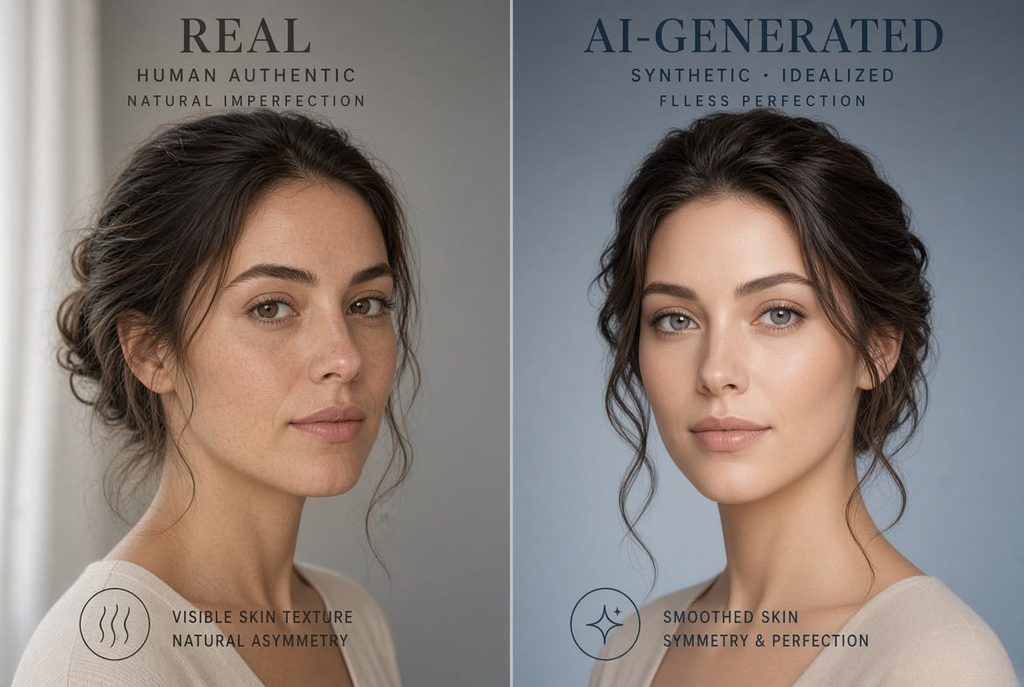
The “Too Perfect” Problem
Generative AI creates an interesting paradox.
People have spent years trying to make their online photographs look better.
Now, looking too perfect can sometimes create suspicion.
Perfect skin. Perfect lighting. Perfect backgrounds. Identical facial expressions. Highly polished images without the small inconsistencies normally found across photographs taken on different days.
None of those things proves an image is generated.
Professional photographers can produce exceptional work, and aggressive photo editing existed long before generative AI.
But visual perfection should no longer automatically be interpreted as authenticity.
Meet An Escort’s own scam guidance recommends paying attention to profile photos that appear unusually perfect or generic and checking whether photographs consistently depict the same person.
That is increasingly useful advice across the internet, not just adult directories.
Reverse Image Search Still Helps, but It Isn’t Enough
One of the traditional ways to identify a fake profile is reverse image searching.
If the same photograph appears under different names across dozens of websites, that’s an obvious warning sign.
The method remains useful.
But generative AI introduces a weakness.
A completely synthetic photograph may never have appeared anywhere else online.
Reverse image search could therefore return nothing.
Ironically, a scammer using an original AI-generated image could potentially avoid one of the checks that previously helped identify stolen photographs.
That doesn’t make reverse image search obsolete.
It means it should be one part of a broader verification process rather than the only test.
Consistency Across a Profile Matters
Authenticity is rarely established by one signal.
It is usually a collection of signals that make sense together.
Does the same person appear consistently across different photographs?
Does the written profile sound coherent?
Does the location make sense?
Are the communication methods consistent?
Has the platform performed identity verification?
Do screening expectations and availability information look realistic?
Does communication after initial contact remain consistent with what was stated publicly?
No individual signal guarantees authenticity.
Together, however, they create a much stronger picture.
This is one reason directory-level verification has value. Individual visitors don’t have to make every trust decision based entirely on visual intuition.
AI Detection Isn’t a Perfect Solution Either
It would be convenient if websites could simply run every photograph through software and receive a definitive answer:
REAL or AI GENERATED.
Unfortunately, reality is more complicated.
AI detection systems are engaged in a constant race with generation systems. As synthetic images improve, detection becomes harder. Images can also be resized, compressed, cropped, filtered, or edited after generation.
False positives create another problem.
A genuine photograph that has been heavily retouched might appear suspicious to an automated system. Conversely, a sophisticated generated image might pass.
Detection technology will undoubtedly improve, but adult platforms shouldn’t depend on it exclusively.
Identity verification, moderation, behavioral signals, reporting systems, and human review can all contribute to a stronger trust system.
Disclosure Is More Useful Than Pretending AI Doesn’t Exist
There is another approach worth considering:
clear disclosure.
Synthetic media isn’t inherently problematic when people know it’s synthetic.
A fictional AI character advertised as a fictional AI character isn’t impersonating anyone.
An AI-generated adult video presented as generative entertainment isn’t claiming that the depicted scenario actually happened.
Problems emerge when the boundaries are intentionally hidden.
This suggests that the adult internet may gradually develop clearer categories.
Some platforms will specialize in real people.
Others will specialize in AI-generated characters and fantasy.
Some may contain both, but label them distinctly.
Users can then decide which experience they want.
That’s far healthier than forcing every platform to pretend synthetic media doesn’t exist.
Consent Becomes Part of the Authenticity Question
There is another reason adult AI requires thoughtful boundaries: the source material.
Creating a fictional adult character is one thing.
Using an identifiable real person’s photograph to create sexual material without permission is something very different.
The fact that technology makes an alteration possible doesn’t mean the subject of a photograph consented to that use.
This distinction should remain central as image transformation and image-to-video tools become more capable.
Responsible adult AI platforms need clear rules around uploaded material, age restrictions, prohibited content, and the use of images depicting real people.
Likewise, users should understand that finding a photograph publicly online does not automatically create permission to transform it into explicit material.
Digital fantasy can remain creative without abandoning basic principles of consent.
Privacy Matters on Both Sides
Authenticity receives much of the attention, but privacy is equally important.
Adult activity has always required a higher degree of discretion than many other online categories.
Clients may not want browsing activity attached to public identities. Independent providers have legitimate reasons to protect personal information. Users of adult AI platforms may not want private interests or uploaded media retained unnecessarily.
Meet An Escort’s current privacy guidance emphasizes practical discretion around communication, devices, payments, calendars, and information sharing.
Generative AI adds another dimension.
Users should understand what happens to material they upload.
Is it stored?
For how long?
Can it be deleted?
Is it used to improve models?
Who can access it?
These questions should become routine whenever personal imagery is involved.
Real People May Become More Valuable in an AI-Rich Internet
There is an interesting possibility that doesn’t receive enough attention.
As artificial experiences improve, authentic human interaction may become more valuable.
Imagine an internet where convincing fictional personalities, photographs, videos, and conversations can be generated almost instantly.
In that environment, knowing that you’re interacting with an actual person becomes distinctive.
Human interaction contains things synthetic media doesn’t perfectly reproduce: spontaneity, independent preferences, mutual boundaries, genuine conversation, and the unpredictability that comes from two people participating.
This doesn’t diminish AI fantasy.
It clarifies the difference.
AI can provide highly customizable digital experiences.
Human companionship provides authentic interpersonal experiences.
Both can exist without competing for exactly the same role.
Adult Platforms Will Need Stronger Trust Signals
For platforms connecting real people, the next few years will probably require more sophisticated approaches to trust.
A profile containing attractive photographs and a phone number won’t be enough.
Users may increasingly look for additional signals such as:
identity verification;
recent verification;
consistent profile history;
platform moderation;
clear reporting mechanisms;
transparent screening expectations;
and evidence that the person communicating matches the person represented.
Some of these systems already exist.
Generative AI simply increases their importance.
The platforms that invest in trust now may find themselves better positioned as synthetic media becomes increasingly difficult to distinguish visually.
Users Need Better Digital Literacy Too
Platforms can’t solve everything.
Users also need to become more skeptical about what they see online.
That doesn’t mean assuming every attractive photograph is fake.
It means moving away from the idea that visual quality equals credibility.
A healthy approach is straightforward:
Treat photographs as one piece of information.
Look for verification.
Read the complete profile.
Check whether details are internally consistent.
Be cautious when someone immediately pressures you for money.
Use established communication and screening practices.
Pay attention when something doesn’t add up.
Meet An Escort’s existing booking guidance similarly emphasizes choosing verified profiles, protecting personal information, communicating appropriately, and watching for warning signs rather than relying on appearances alone.
Those habits will become increasingly relevant throughout the broader internet.
The Future Isn’t “Real Versus AI”
It’s tempting to frame the future of adult technology as a competition.
Real people versus AI characters.
Traditional adult content versus generated content.
Human companionship versus virtual experiences.
That framing is probably too simplistic.
The more likely future contains all of them.
Someone might use generative AI to explore a fantasy privately one evening and seek genuine companionship another time.
Someone might follow real creators while also experimenting with fictional AI characters.
A creator might use AI-assisted tools as part of an otherwise human production workflow.
The categories will overlap.
What matters is that users know which category they’re interacting with.
Trust Will Become a Feature
For years, technology companies treated trust as something users simply granted.
That era is disappearing.
When images, voices, videos, and even conversations can be synthesized, trust has to be earned through signals beyond the content itself.
For adult AI platforms, that means being clear about what is generated and establishing responsible boundaries around how generation tools are used.
For adult directories, it means demonstrating that profiles representing real people actually belong to real people.
And for users, it means developing habits that don’t depend entirely on whether something looks convincing.
Generative AI isn’t going away.
Neither is the desire for genuine human companionship.
The adult platforms that thrive in this environment won’t necessarily be those that choose one side.
They’ll be the ones that make the distinction unmistakable.
Because in a world where almost anything can be generated, knowing when something is real becomes valuable information in its own right.
Leave a Reply